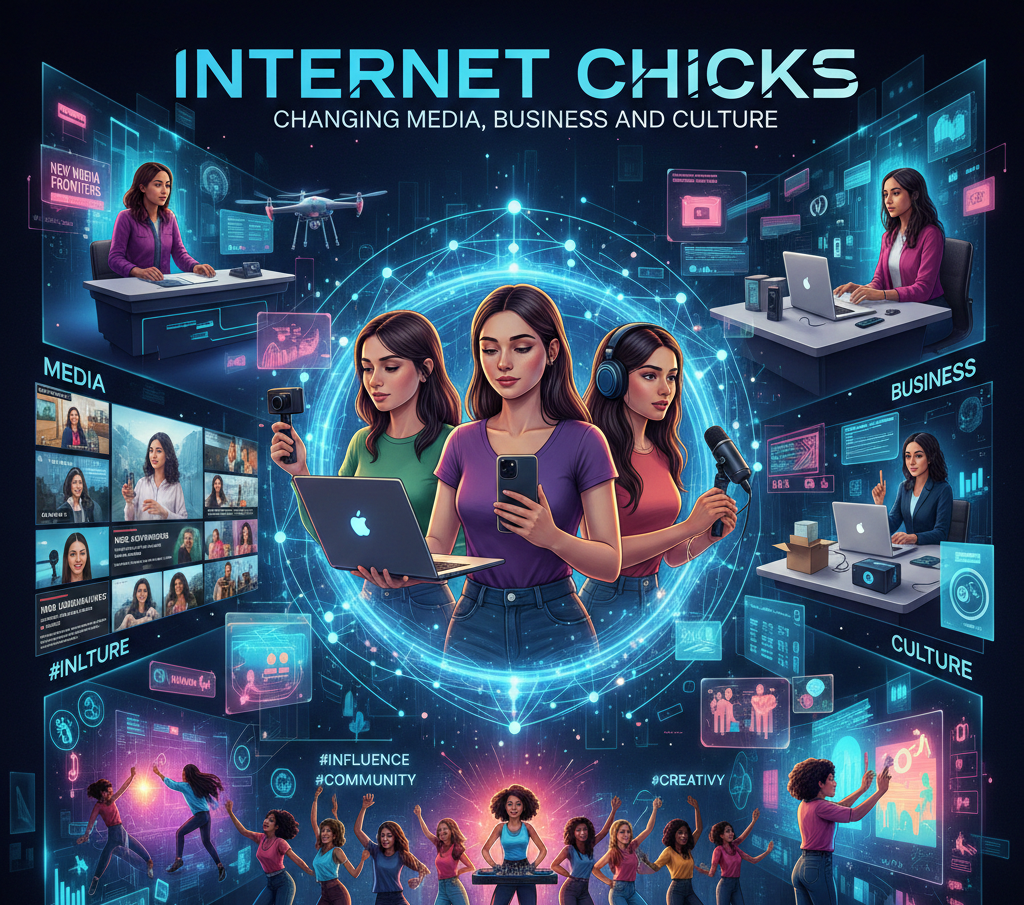
How Internet Chicks Are Changing Media, Business, and Culture
📌 Key Takeaways
- Internet chicks — women who build influence, income, and identity online — are a defining force in the modern creator economy, estimated at over $480 billion globally.
- Female creators now set cultural trends faster than traditional fashion houses, beauty brands, and media networks.
- Women dominate content creation on Pinterest (77%), TikTok (57%), and Instagram (51%), yet often receive less brand deal compensation than male peers.
- The influencer marketing industry is projected to surpass $50 billion annually by 2028, with female creators at its core.
- Beyond content, internet chicks are launching products, leading movements, and reshaping what career success looks like for a generation of women.
What Are “Internet Chicks”? Defining the Term
In modern digital culture, “internet chicks“ is a widely used, colloquial term referring to women who are prominent, creative, influential, or entrepreneurial in online spaces. It describes a broad and diverse group — not a single type of person or content niche.
An internet chick might be:
- A TikTok creator with 10 million followers teaching personal finance
- A YouTube vlogger documenting sustainable living with an audience of loyal subscribers
- A Twitch streamer building a gaming community from scratch
- A Substack writer running a six-figure newsletter business
- An Instagram entrepreneur who turned an engaged following into a physical product line
- A podcaster breaking down business strategy for women founders
The term is colloquial, but its significance is real. It captures a generation of female digital creators who built influence independently — without needing a studio, a network deal, or a corporate sponsor. They leveraged technology, consistency, and authenticity to claim space in a landscape that was not originally designed to center them.
Quick Answer — What does “internet chick” mean? An internet chick is a woman who uses digital platforms — such as YouTube, TikTok, Instagram, Twitch, or Substack — to build meaningful influence, a loyal audience, or a profitable business through creative online content.
2. A Brief History: How Internet Chicks Emerged
Understanding where internet chicks came from helps explain why their influence is so deeply embedded in digital culture today.
Early 2000s — The Blog Era: Women were among the earliest adopters of personal blogging. Platforms like Blogger and LiveJournal gave women a space to write candidly about parenting, fashion, health, and lifestyle. “Mommy bloggers” were among the first to attract brand sponsorships, quietly pioneering the influencer business model a decade before the term existed.
2008–2012 — YouTube’s First Wave: As YouTube opened up video creation to anyone with a camera, female creators dominated in beauty, fashion, and lifestyle. Channels built around makeup tutorials, DIY crafts, and personal vlogs accumulated millions of subscribers — and laid the groundwork for what would become the modern creator economy.
2012–2016 — Instagram and the Visual Creator: Instagram gave women digital influencers a native platform. The visual format suited lifestyle content naturally, and female creators built massive followings around travel, food, fitness, and aesthetic design. For the first time, follower count had direct monetary value through paid partnerships.
2016–2020 — Diversification and the Multi-Platform Creator: Female creators expanded across platforms, built email lists, launched podcasts, and moved beyond single-platform dependency. Creators like Emma Chamberlain (YouTube → fashion industry), Charli D’Amelio (TikTok → brand empire), and Huda Kattan (Instagram → Huda Beauty) demonstrated that digital audiences could be converted into long-term business assets.
2020–Present — The Creator Economy Goes Mainstream: The COVID-19 pandemic accelerated everything. Content creation boomed. New monetization tools — Patreon, OnlyFans, Substack, Instagram Subscriptions, TikTok Shop — gave female creators direct revenue channels that no longer depended on brand approvals. The result: a generation of online female entrepreneurs with full control of their income and audience.
3. Where Internet Chicks Dominate: Platform Breakdown
Different platforms serve different types of internet chicks. Here’s where female creators are most influential — and why each platform matters:
TikTok
TikTok’s algorithm is uniquely meritocratic — it rewards engaging content over established follower counts, making it the most accessible platform for new female creators to grow quickly. Women make up approximately 57% of TikTok’s creator base. The platform has produced viral female voices in every category: finance (Tori Dunlap / Her First 100K), food, wellness, humor, and social commentary. TikTok Shop has also become a powerful revenue channel, with female creators driving significant e-commerce volume through live shopping and affiliate content.
YouTube
YouTube remains the most mature monetization ecosystem for female creators. Long-form content created by women in beauty, education, personal finance, and lifestyle generates billions of views annually. YouTube’s Partner Program, channel memberships, and Super Thanks features give creators multiple income streams. YouTube also functions as a career résumé — deep, searchable content that compounds in value over time.
Instagram is the original home of the lifestyle influencer — and women have dominated this space since the platform’s early days. While organic reach has declined, Instagram remains the premier platform for brand partnerships and sponsored content, especially in beauty, fashion, wellness, and parenting. Female micro-influencers (10K–100K followers) command premium engagement rates, making them the most sought-after tier for brand deals.
Twitch & YouTube Gaming
Gaming has historically been male-dominated, making the rise of female streamers particularly significant. Creators like Pokimane (Imane Anys) — one of Twitch’s most-followed streamers — have proven that women can build massive gaming communities and translate them into brand deals, merchandise, and media appearances. Female gaming creators have actively shifted the culture of online gaming toward inclusion.
Substack & Newsletters
The newsletter renaissance has created a powerful lane for women writers and thinkers. Female creators on Substack are building six-figure subscription businesses by covering topics ranging from investigative journalism and cultural criticism to personal finance and career advice. Unlike social platforms, newsletters offer owned audiences — no algorithm dependency.
Podcasting
Women are among the most listened-to podcast creators globally. Shows hosted by women covering business, relationships, wellness, and true crime consistently rank in the top charts. Podcasting has given female creators a medium that rewards depth, expertise, and voice — and provides strong sponsorship revenue for audiences in valuable niches.
4. Real-World Examples of Internet Chicks Who Changed the Game
These are not just creators — they are entrepreneurs, culture-shapers, and business builders who prove what’s possible when women build online.
Huda Kattan — Started as a beauty blogger and Instagram creator. Built Huda Beauty into a cosmetics brand valued at over $1 billion. Her trajectory from digital content to product empire is a blueprint replicated by thousands of female creators since.
Emma Chamberlain — Began on YouTube as a teenager with an unpolished, relatable style that disrupted the overly-produced beauty vlogger format. Grew to millions of subscribers, landed a Louis Vuitton ambassador deal, launched her own coffee brand (Chamberlain Coffee), and became a Met Gala regular. Her rise redefined what “influencer” could mean as a career.
Charli D’Amelio — Became TikTok’s most-followed creator before age 18. Converted her platform into a family reality show on Hulu, a shoe collaboration with Puma, a mobile game, and a Dunkin’ brand partnership. Demonstrated how fast a single platform could generate cross-media business value.
Tori Dunlap — Built a personal finance platform specifically for women, amassed millions of TikTok and Instagram followers, and parlayed her audience into a bestselling book, a podcast, and a full media company. One of the clearest examples of an internet chick turning niche expertise into a diversified business.
Pokimane (Imane Anys) — One of the most-followed female streamers in the world. Built her Twitch and YouTube gaming community into brand deals with major companies, launched her own snack brand (Myna Snacks), and became a co-founder of OfflineTV, a creator collective. A pioneer in legitimizing gaming as a female-led professional space.
Iman Gadzhi — While male, his female equivalents in the education space — creators like Rachel Rodgers and Simonel — have built multi-million dollar online education businesses through courses and coaching, entirely audience-first.
These examples span beauty, gaming, finance, lifestyle, and education — proof that there is no single template for what an internet chick looks like or builds.
5. How Internet Chicks Are Reshaping Media
From Gatekeeping to Self-Publishing
Traditional media was built on gatekeeping. Editors, producers, and network executives controlled who received a platform. Women online creators bypassed this system entirely — and in doing so, exposed how much talent had been excluded from it.
A woman with a smartphone, a clear point of view, and consistent output can now reach millions without a single gatekeeper’s approval. TikTok’s algorithm actively rewards engaging content regardless of a creator’s network, credentials, or industry connections. This democratization has allowed women digital influencers to build audiences that rival — and in many cases surpass — legacy media outlets in reach, trust, and engagement.
Quick Answer — What is the impact of female creators on digital media? Female creators have decentralized media production by enabling direct audience relationships, pioneering authentic storytelling formats, and building niche content categories that legacy outlets could not serve — forcing traditional media to evolve or lose relevance.
Niche Content Became Mass Media
One of the most important media contributions of internet chicks is proving that niche content is scalable. Topics once considered too specific for mainstream TV — natural hair care, sustainable fashion, mental health for women of color, female entrepreneurship, chronic illness living — now command audiences in the millions.
Major publications have responded by hiring digital-native female creators as contributors and columnists. Television networks are developing shows directly inspired by YouTube and TikTok formats pioneered by women. The niche-to-mainstream pipeline is now a standard content strategy — and female creators built it.
Authenticity as a Media Standard
Female content creators are widely credited with popularizing authentic, unfiltered storytelling in digital media. The “Get Ready With Me,” “Day in My Life,” and “Story Time” formats — invented and dominated by women — fundamentally changed audience expectations: honesty and vulnerability over production polish.
This shift is now an industry standard. Brands, news organizations, and entertainment companies have all adopted authenticity-first content strategies modeled directly on what female creators proved worked.
The Rise of the Creator-as-Media-Company
The most successful internet chicks are no longer just creators — they are media companies. They produce content across multiple formats (video, podcast, newsletter, social), employ editors and managers, license IP, and operate with the organizational structure of a small publisher. This evolution has blurred the line between “influencer” and “media executive” — and many are now both.
6. How Internet Chicks Are Transforming Business
The Creator Economy Is Largely Female-Driven
The creator economy is estimated to be worth over $480 billion globally (Goldman Sachs, 2023), with projections of significant continued growth through 2030. Women are disproportionately central to this economy — representing the majority of active creators on Pinterest (77%), TikTok (57%), and Instagram (51%).
Women content monetization has evolved far beyond brand deals. Today’s female creators monetize through:
- Subscription platforms — Patreon, Substack, OnlyFans, Instagram Subscriptions
- Digital products — online courses, e-books, Notion templates, presets
- Physical product lines — beauty, fashion, wellness, food and beverage
- Membership communities — paid Discord servers, private forums, mastermind groups
- Licensing and media deals — book deals, TV development, podcast network partnerships
- Live events and retreats — workshops, conferences, brand-funded experiences
- Affiliate marketing — passive revenue from product recommendations at scale
Female-led brands born from social media audiences — Huda Beauty, Chamberlain Coffee, Her First 100K, Myna Snacks — demonstrate that an engaged online audience is a more powerful business asset than traditional advertising spend.
Influencer Marketing’s Most Valuable Segment
The influencer marketing industry is projected to exceed $50 billion annually by 2028. Female creators represent its most valuable and active segment. Brands in beauty, fashion, food, wellness, parenting, and personal finance have consistently found that female-led content marketing outperforms traditional advertising in both engagement rate and purchase conversion.
Female micro-influencers — creators with audiences between 10,000 and 100,000 — have emerged as the highest-value tier for brand partnerships, commanding engagement rates 3–5x higher than mega-influencers while costing a fraction of the price. This has created an entire supporting economy: talent managers, MCNs (multi-channel networks), brand partnership agencies, and content studios built specifically around female creator output.
Redefining Career Success
Internet chicks have fundamentally rewritten what career success looks like for a generation of younger women. The concept that a woman with expertise, personality, and consistent content can build a six-figure or seven-figure business independently — without a corporate employer, an advanced degree, or a venture capital backer — has disrupted institutional assumptions about economic mobility and professional aspiration.
Universities are now offering courses on creator economy business models. Major employers are recruiting from the creator talent pool. The skills developed by successful female creators — audience analytics, content strategy, community building, brand negotiation — are being recognized as serious professional competencies with real market value.
7. How Internet Chicks Are Influencing Culture
Setting Trends Faster Than Fashion Houses
Female creators now set trends in real time — at a pace that no traditional industry can match. A beauty technique demonstrated on TikTok by a creator with 2 million followers can sell out a product within 24 hours. A fashion styling choice by a prominent creator can spark a micro-trend that spreads across three continents within 48 hours.
Traditional fashion and beauty industries operated on seasonal production cycles measured in months. Internet chicks operate on cycles measured in hours. The industry has been forced to adapt — with fast-fashion brands launching “influencer response” product lines, and luxury houses collaborating with digital creators to stay culturally relevant to younger audiences.
Redefining Beauty and Body Standards
One of the most culturally significant impacts of internet chicks is the genuine broadening of mainstream beauty standards. Before the influencer era, the definition of beauty in advertising was controlled by a narrow group of brand marketers and fashion editors who favored a very limited physical archetype.
Female creators changed this at scale. Plus-size creators, women of color, disabled women, women over 40, and LGBTQ+ creators built millions-strong audiences celebrating beauty as they actually lived it — not as the industry prescribed it. Brands that failed to reflect this diversity faced public pressure and declining engagement; brands that embraced it saw measurable loyalty gains among younger, digitally native consumers.
Building Community Around Previously Taboo Topics
Female creators have transformed topics that were once considered too personal or taboo for public discussion into thriving online communities. Postpartum depression, miscarriage, fertility struggles, financial shame, career burnout, relationship trauma, chronic illness, neurodivergence — these subjects now have communities built around them with tens of millions of members.
The impact is not just cultural. These communities provide peer support, shared knowledge, and solidarity that many participants cannot access from traditional institutions. In doing so, internet chicks have built the kind of accessible, scalable support infrastructure that healthcare systems, governments, and corporations have failed to provide.
Political and Social Advocacy at Scale
Women with large online platforms have increasingly deployed their cultural capital for advocacy with measurable real-world outcomes. Voter registration campaigns run through Instagram Stories have reached millions. Mental health awareness campaigns have driven spikes in helpline calls. Fundraising campaigns activated through female creator networks have generated millions for causes within days.
This form of digital civic influence — once dismissed as soft power — has proven capable of mobilizing action at a scale that traditional journalism, political advertising, and nonprofit campaigns often cannot match.
8. Challenges Faced by Internet Chicks
No complete analysis of internet chicks can ignore the substantial barriers they navigate. Despite their outsized influence, women online creators face disproportionate and persistent challenges:
Online harassment and misogyny remain widespread. Female creators — particularly those who speak on politics, gaming, or topics considered traditionally male — face coordinated harassment campaigns, doxxing, and threats that their male peers rarely experience at equivalent rates or severity.
Algorithmic bias has been documented across multiple platforms, with content created by and for women — particularly women of color — suppressed or deprioritized relative to equivalent content from male creators. This represents a structural disadvantage embedded in the infrastructure of the creator economy.
Mental health pressure from constant public visibility, audience expectations, parasocial relationships, and the never-ending content production cycle is a documented crisis among female creators. Burnout, anxiety, and identity struggles are common — and platforms provide minimal structural support.
Intellectual property theft — including uncredited reposts, stolen formats, and appropriated aesthetics — disproportionately affects female creators who build original content, often without the legal resources to pursue remedies.
Pay gaps in brand partnerships are real and documented. Female creators are routinely offered lower compensation than male creators with equivalent or smaller audiences, particularly in gaming and technology verticals. Advocacy organizations and creator communities are actively pushing for greater pay transparency in the influencer marketing industry.
These are not peripheral issues — they are structural problems that affect the sustainability and equity of the creator economy as a whole.
9. The Future of Internet Chicks
The momentum behind internet chicks is accelerating, not plateauing. Several clear trends define what comes next:
AI-Augmented Creation will lower barriers further. Female creators are already using AI tools to scale content production, translate into multiple languages, generate thumbnail variations, and analyze audience data more efficiently. Those who master AI as a creative tool will disproportionately benefit from output scale without proportional increases in workload.
Owned Audiences and Direct Monetization will define the next strategic shift. The smartest internet chicks are moving from platform dependency toward owned distribution — newsletters, communities, apps, and direct subscription relationships that no algorithm can take away. This shift toward ownership represents a maturation of the creator business model.
Institutional Integration is accelerating. Female creators are being recruited as brand CMOs, media executives, board advisors, and university lecturers. The skills forged in the creator economy — audience understanding, content strategy, digital community management — are being absorbed by legacy institutions that finally recognize their strategic value.
Web3 and Digital Ownership offer a longer-term frontier. Creator tokens, digital goods, and decentralized community ownership models are still early, but they represent a potential next layer of audience monetization that female creators — already experienced in direct community relationships — are well-positioned to leverage.
Collaborative Creator Networks are growing. Rather than competing as solo operators, leading female creators are forming collectives, co-owned media companies, and shared platforms that give them negotiating leverage, cross-promotion reach, and collective business scale. This trend points toward a more structured, institutionalized future for the creator economy.
The women who mastered the internet are now actively shaping what comes after it.
Frequently Asked Questions
Q: What does “internet chick” mean in digital culture? An internet chick is a woman who uses digital platforms — such as YouTube, TikTok, Instagram, Twitch, or Substack — to build influence, a loyal audience, or a profitable business through creative online content and authentic community engagement.
Q: Are internet chicks only influencers? No. While many are content creators or influencers, internet chicks also include online entrepreneurs, female streamers, podcasters, newsletter writers, course creators, and community builders. Many combine multiple roles simultaneously.
Q: How are female content creators changing the media industry? Female creators have decentralized media production, popularized authentic storytelling, and created niche content categories that rival traditional media in reach and audience trust — forcing legacy outlets to follow their lead.
Q: What platforms do internet chicks dominate? Women are the majority creator demographic on Pinterest (77%), TikTok (57%), and Instagram (51%). They are also highly influential in YouTube, Substack, and the podcasting space, with growing representation on Twitch.
Q: Why are women influencers so important to the creator economy? Women represent the majority of content creators across most major platforms and are central to the influencer marketing industry projected to exceed $50 billion annually by 2028. Their community-building ability and audience trust make them the most valuable segment of creator marketing.
Q: What challenges do internet chicks face online? Key challenges include online harassment, algorithmic bias against female-created content, mental health pressures from constant visibility, intellectual property theft, and documented pay gaps in brand partnership compensation.
Q: How do internet chicks make money? Monetization methods include brand sponsorships, affiliate marketing, subscription platforms (Patreon, Substack), digital products (courses, e-books), physical product lines, community memberships, live events, licensing deals, and direct platform revenue programs.
Q: What is the future of internet chicks in media and business? Internet chicks will continue growing in influence through AI-augmented content creation, owned audience strategies (newsletters, apps), creator collectives, institutional integration, and emerging Web3 ownership models.
Conclusion
Internet chicks are not a trend, a moment, or a marketing category. They are a structural force that has permanently altered how media is made, how business is built, and how culture moves.
They bypassed gatekeepers and built their own platforms. They turned authenticity into strategy. They transformed personal experience into community, and community into commerce. They made the internet feel more human — more diverse, more honest, and more reflective of the people who actually use it.
The $480 billion creator economy they anchor, the influencer marketing industry they power, the beauty standards they broadened, the communities they built around topics institutions ignored — these are not small contributions. They are foundational shifts.
And the women building these platforms from scratch — one video, one post, one community at a time — have demonstrated something that no business school can fully teach: the most powerful form of media is a real person, telling the truth, to an audience that genuinely listens.