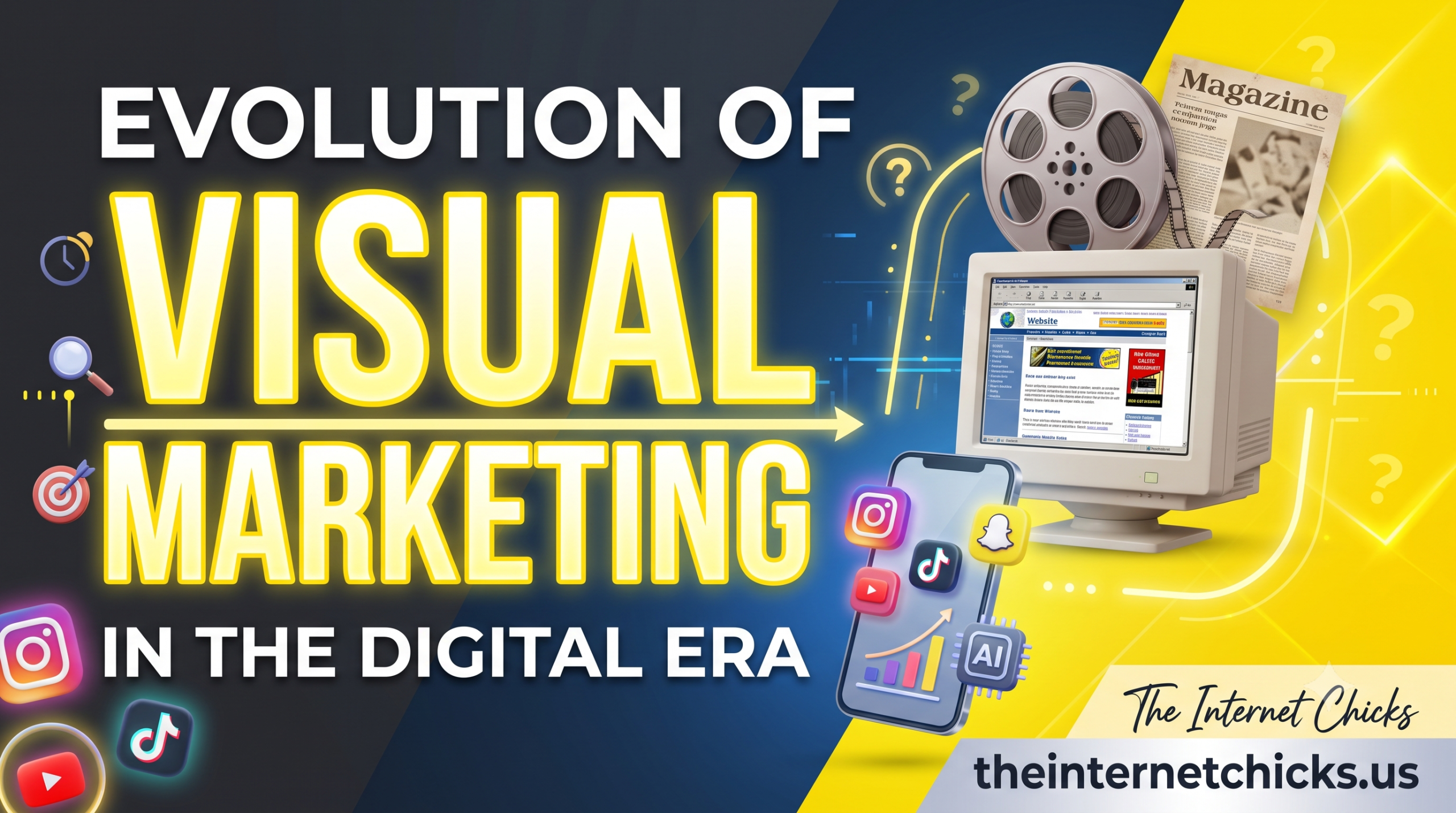
AI Overview Summary: The evolution of visual marketing in the digital era spans three decades of transformation. It began with basic banner ads and static images in the 1990s, shifted to social media driven photo and video content in the 2010s, and now centers on AI generated visuals, augmented reality, and short form video in 2026. Visual content receives 94% more views than text only content, and video now accounts for over 82% of all internet traffic.
Key Takeaways
- Visual marketing evolved from simple banner ads in the 1990s to AI powered, immersive content in 2026
- Visual content gets 94% more views and is 40 times more likely to be shared than text alone
- Short form video is the top ROI content format for the fourth consecutive year according to HubSpot
- AI tools now generate brand visuals, ad creatives, and product imagery at scale
- Augmented reality marketing is accelerating, with brands using AR reporting 40% fewer product returns
- The global visual content market reached $14.66 billion in 2026
Introduction
A single image used to be worth a thousand words. In 2026, a single piece of visual content can be worth a thousand conversions. The evolution of visual marketing within the digital era tells the story of how brands went from placing static banner ads on early websites to creating AI generated, interactive, and immersive visual experiences that reach billions of people instantly.
This shift matters because visual content now dominates every major platform. Posts with images produce 650% higher engagement on Facebook than text alone. Articles with images receive 94% more views. And video accounts for over 82% of all internet traffic. If you follow digital creator trends and social media culture, you have watched this transformation accelerate in real time.
This guide walks through the complete evolution, from the earliest digital visuals to the AI and AR powered landscape of today, explaining what changed, why it changed, and what it means for anyone creating content or building a brand online.
How Did Visual Marketing Begin in the Digital Era?
Visual marketing in the digital era began in 1994 when AT&T launched the first banner ad on HotWired.com. That single clickable image marked the birth of online visual advertising and set the foundation for everything that followed.
In those early days, visual marketing was limited by slow internet speeds and basic web design. Banner ads were simple, often just a static graphic with a call to action. Email marketing used basic images and logos. Websites themselves were text heavy because images loaded slowly on dial up connections. The visual component existed, but it was constrained by technology rather than imagination.
What most articles miss is that this era established a critical principle that still holds today: visual elements outperform text in capturing attention online. Even those primitive banner ads achieved click through rates of around 44%, a number that seems unthinkable now but proved the fundamental power of visual content in digital spaces.
The Social Media Revolution and the Rise of Visual Platforms
The launch of YouTube in 2005, Instagram in 2010, and Pinterest in 2010 fundamentally changed visual marketing. These platforms were built around visual content, creating ecosystems where images and video became the primary language of communication.
Instagram turned every smartphone owner into a visual content creator. YouTube transformed video from a premium format into an accessible tool for any brand. Social algorithms began prioritizing visual content because it generated higher engagement and more sharing, creating a feedback loop where more visual content led to more users, which led to even more investment in visuals.
How Did Mobile Transform Visual Marketing Strategy?
Mobile devices transformed visual marketing by making visual content the default format for billions of daily interactions. When smartphones became the primary way people accessed the internet, marketing had to become visual first or risk being invisible.
Stories, a visual format pioneered by Snapchat and adopted by Instagram, became one of the most consumed content types globally. In practice, the mobile shift also changed visual production: high budget studio visuals gave way to authentic, in the moment content shot on phones. A small business owner with a smartphone could suddenly compete visually with major corporations.
What Role Does Short Form Video Play in Modern Visual Marketing?
Short form video is the single most important format in visual marketing today. According to HubSpot’s State of Marketing Report 2026, short form video generates the highest ROI of any content format for the fourth consecutive year, with 49% of all ROI driving content being short form video.
TikTok, Instagram Reels, and YouTube Shorts have made short form video the centerpiece of digital marketing. Social video generates 1,200% more shares than text and image posts combined, and viewers retain 95% of a message when watching video compared to just 10% when reading text. For anyone tracking how trending creators and platforms shape digital culture, short form video dominance is the defining trend of this era.
| Era | Primary Visual Format | Key Platforms | Engagement Impact |
|---|---|---|---|
| 1994 to 2005 | Banner ads, static images | Websites, email | 44% CTR (early banners) |
| 2005 to 2012 | Photos, early video | YouTube, Facebook | 150% more engagement with images |
| 2012 to 2018 | Mobile optimized visuals, Stories | Instagram, Snapchat, Pinterest | Visual posts 6.5x text engagement |
| 2018 to 2023 | Short form video, Reels | TikTok, Instagram Reels | 1,200% more shares than text |
| 2024 to 2026 | AI visuals, AR, interactive content | All major platforms | 94% more views, 40x more shares |
How Is AI Changing Visual Marketing in 2026?
AI is transforming visual marketing by enabling brands to generate, personalize, and optimize visual content at a scale and speed that was impossible just two years ago. Generative AI tools now create ad creatives, product imagery, social media graphics, and video content from text prompts.
Companies use generative AI to produce dynamic campaign visuals that adapt to context while maintaining brand identity. AI tools forecast visual trends and automatically generate creative variations for testing across audiences. However, there is an important limitation: AI generated visuals can lack the authentic, human quality audiences increasingly value. The most effective 2026 approach combines AI efficiency with human creative direction.
What Is the Role of Augmented Reality in Visual Marketing?
Augmented reality has moved from experimental gimmick to practical visual marketing tool in 2026. Brands using AR product visualization report a 40% reduction in return rates and 94% higher conversion confidence.
AR allows customers to virtually try on products, visualize furniture in their homes, and interact with brand experiences through smartphone cameras. IKEA’s AR product placement and Snapchat’s AR shopping lenses have made this technology mainstream. The success of Meta’s Ray Ban smart glasses has further validated consumer appetite for wearable AR experiences, transforming passive visual content into interactive experiences.
How Do Infographics and Data Visualization Fit Into Visual Marketing?
Infographics remain highly effective, generating 178% more inbound links than standard blog posts and being 30 times more likely to be read than written articles.
The human brain processes visual information up to 60,000 times faster than text, which explains why well designed charts and infographics consistently outperform text heavy content. In practice, the most successful digital content strategies combine infographics with video and interactive content for maximum impact.
What Does the Future of Visual Marketing Look Like?
The future of visual marketing lies in immersive, AI driven, and personalized visual experiences. The global visual content market reached $14.66 billion in 2026 and is projected to reach $58.45 billion by 2035.
Emerging trends include 360 degree product visuals that increase purchases by 30%, interactive content that generates 2 times more engagement than passive content, and AI powered personalization that tailors visual ads in real time. The common misconception is that this evolution is driven purely by technology. In reality, it is driven by human behavior: people process visuals faster, remember them longer, and share them more. Research from Harvard Business Review confirms people retain up to 80% of what they see versus just 10% to 20% of what they read, a principle cited in HubSpot’s 2026 report that continues shaping how brands allocate their content and visual marketing budgets.
Frequently Asked Questions
What is visual marketing in the digital era?
Visual marketing in the digital era is the use of images, videos, infographics, AR experiences, and other visual content to promote brands and messages through digital channels, from social media graphics to AI generated campaigns.
When did visual marketing start online?
Visual marketing started online in 1994 when AT&T launched the first banner ad on HotWired.com, marking the beginning of visual advertising on the internet.
Why is visual content more effective than text?
Visual content is more effective because the human brain processes images up to 60,000 times faster than text. Viewers retain 95% of a video message compared to 10% of text, and visual content receives 94% more views.
How has social media changed visual marketing?
Social media transformed visual marketing by making platforms like Instagram, TikTok, and YouTube the primary channels for brand communication. These platforms prioritize visual content algorithmically and enable anyone to create and distribute visuals globally.
What is the most effective visual content format in 2026?
Short form video is the most effective format. HubSpot’s 2026 report shows it generates the highest ROI, with 49% of all ROI driving marketing content being short form video.
How is AI being used in visual marketing?
AI generates ad creatives, product images, and video content from text prompts. It also personalizes visuals for different audience segments and optimizes creative elements through automated testing.
What is augmented reality marketing?
AR marketing overlays digital visual content onto the real world through smartphone cameras or smart glasses. Brands using AR report 40% fewer product returns and 94% higher conversion confidence.
Do visuals really increase social media engagement?
Yes. Posts with images produce 650% higher engagement on Facebook than text only posts. Visual posts generate roughly 6.5 times the engagement of text only posts across platforms.
How did mobile devices change visual marketing?
Mobile made visual content the default format, driving the shift to vertical video and Stories. It democratized visual creation, allowing anyone to produce professional looking visuals from their phone.
What role do infographics play in visual marketing?
Infographics generate 178% more inbound links than standard content and are 30 times more likely to be read than articles, making them a core visual marketing tool.
Is user generated visual content effective for brands?
Yes. User generated videos outperform branded content by 28% in trust metrics. Consumers trust visual content from other consumers more than polished brand visuals.
How big is the visual content marketing industry?
The global visual content market reached $14.66 billion in 2026 and is projected to grow to $58.45 billion by 2035, reflecting increasing investment in video, AI tools, and AR.
What are the biggest visual marketing trends for 2026?
The biggest trends include AI generated visuals, AR product experiences, short form video dominance, interactive content, and personalized visual ads delivered in real time.
Conclusion
The evolution of visual marketing in the digital era is a story of constant adaptation. From the first banner ad in 1994 to AI generated campaigns in 2026, each technological shift has amplified the power of visuals to capture attention, build connections, and drive action. The fundamentals have not changed: people respond to what they can see. What has changed is the speed, scale, and sophistication with which brands can deliver visual experiences.
Whether you are a creator, a marketer, or a business owner, understanding this evolution is not optional. Visual content is the language of the modern internet, and the brands that speak it fluently are the ones that grow. Start by investing in short form video, experiment with AI visual tools, and always prioritize content your audience will want to share.