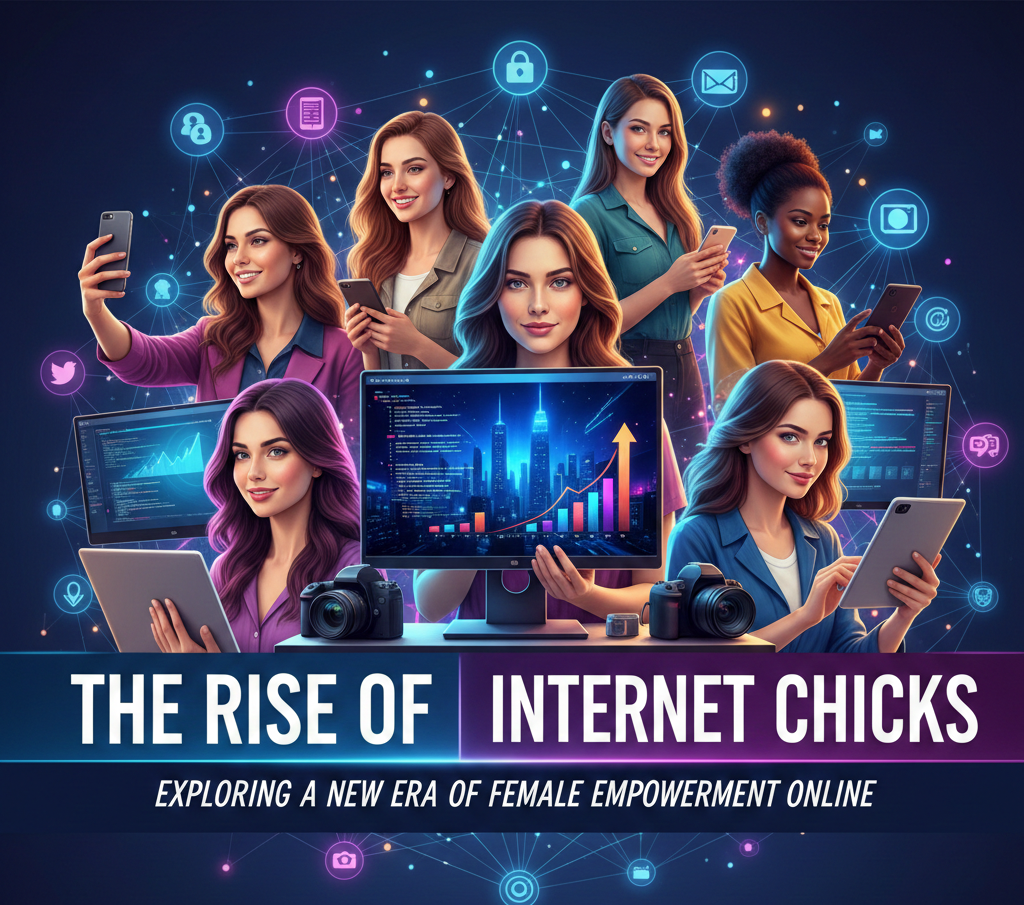
The Rise of Internet Chicks: Exploring a New Era of Female Empowerment Online
Something fundamental has changed in how women experience power.
For most of recorded history, female power was circumscribed — by law, by custom, by gatekeepers who controlled access to platforms, publications, and public discourse. A woman who wanted to be heard needed permission: a publisher’s contract, a network deal, an employer’s approval, a husband’s blessing. The structures that determined who got a voice were almost entirely controlled by others.
The internet broke that structure. Not perfectly, not completely — but undeniably.
Today, a woman with a smartphone, a perspective, and the courage to share it can build a global audience, generate income, start a movement, and reshape cultural conversations — without a single gatekeeper’s consent. This is not a small thing. It is one of the most significant shifts in the history of female agency.
Internet chicks — women who have claimed digital space as a medium for expression, enterprise, and empowerment — sit at the center of this shift. They are not a demographic or a marketing category. They are a movement. And understanding what they are building, and why it matters, is essential for understanding where the world is going.
This article is about that movement: where it came from, what it has created, what it is still fighting, and what it promises for the women who will follow.
Quick Answer — What is female empowerment online? Female empowerment online refers to women using digital platforms — social media, content creation, e-commerce, and online communities — to achieve financial independence, amplify their voices, claim visibility on their own terms, challenge societal norms, and build support networks that were previously inaccessible through traditional institutions.
What Does “Female Empowerment Online” Really Mean?
Empowerment is a word that gets used so often it risks losing its meaning. So it’s worth being precise about what female empowerment online actually looks like — in practice, in daily life, and in measurable outcomes.
At its core, digital female empowerment means control: control over one’s narrative, income, audience, time, and identity. It is the ability to decide what story you tell, who hears it, what you charge for your expertise, and how you show up in public life — without those decisions being filtered through institutions that may not have your interests at heart.
For internet chicks, empowerment manifests in several concrete ways:
Economic empowerment — earning income directly from an audience, without depending on an employer who may discriminate, underpay, or limit advancement. A female creator with 50,000 loyal subscribers on Substack earns income that no manager can reduce, no corporate restructuring can eliminate, and no glass ceiling can cap.
Narrative empowerment — telling your own story, in your own words, to an audience that chose to listen. This is a form of power that was historically available only to those who could get published, broadcast, or otherwise approved by existing media institutions.
Community empowerment — finding and building solidarity with other women across geographies, backgrounds, and experiences. Online communities have given women access to peer support, shared knowledge, and collective action at a scale that no local institution could offer.
Visibility empowerment — being seen. For women whose bodies, identities, and experiences were historically excluded from mainstream media, online visibility is not vanity — it is a radical act of presence.
Together, these forms of empowerment constitute something genuinely new in the world. Not perfect. Not without cost. But real.
3. From Silence to Influence: A History of Women Online
The story of internet chicks is the story of women systematically finding and claiming space in a medium that wasn’t designed with them in mind — and transforming it in the process.
The Early Internet (1990s–Early 2000s): The internet’s early architecture was built predominantly by men, for men. Women who participated in early online spaces — forums, chat rooms, early blogging platforms — often did so anonymously or under gender-neutral usernames to avoid harassment. Visibility meant risk. Yet women persisted, using text-based platforms to build communities around shared interests, experiences, and mutual support that mainstream culture ignored.
The Blogging Era (2003–2009): The rise of accessible blogging platforms — WordPress, Blogger, LiveJournal — gave women a structured medium for long-form personal expression. The “mommy blogger” phenomenon, often dismissed as trivial at the time, was in retrospect a revolutionary development: women writing honestly about parenting, relationships, mental health, and identity, building loyal readerships of millions, and attracting the first wave of brand sponsorships. They invented influencer marketing before the term existed.
The Social Media Explosion (2010–2016): Facebook, Twitter, Instagram, and YouTube democratized visibility at scale. Female creators built massive followings by sharing beauty tutorials, lifestyle content, fitness journeys, and personal stories. For the first time, a woman’s online presence had direct, quantifiable economic value. The number of women who built full-time careers from content creation during this period — without agents, managers, or studio backing — was unprecedented in media history.
The Creator Economy Matures (2016–2020): Female creators moved beyond single-platform dependency, building diversified income streams through merchandise, courses, speaking, books, and subscription communities. Creators like Michelle Phan (beauty → entrepreneurship), Lilly Singh (comedy → television), and Rachel Rodgers (finance → multi-million dollar business) demonstrated the full arc of what digital empowerment could build.
The Pandemic Acceleration (2020–Present): COVID-19 brought the world online and compressed years of creator economy growth into months. New monetization tools — TikTok Shop, Instagram Subscriptions, Patreon, Substack — gave female creators direct revenue channels that bypassed brand approval entirely. The result was a generation of women who built economically resilient, audience-owned businesses that no single employer or platform algorithm could fully take away.
The trajectory is clear: each era has given women more tools, more reach, more economic leverage, and more visibility. The movement is not linear — it faces constant resistance — but its direction is unmistakable.
The Five Pillars of Internet Chick Empowerment
What makes an internet chick truly empowered — rather than simply visible — comes down to five foundational pillars that the most impactful female creators consistently embody:
Pillar 1: Authenticity Over Performance
Internet chicks who build lasting empowerment are not performing a curated version of femininity for an audience’s approval. They are sharing genuine perspectives, real experiences, and honest truths — and finding that this authenticity resonates far more deeply than polished perfection. Authenticity is not just a content strategy; it is a declaration of self-ownership.
Pillar 2: Financial Independence
Empowerment without economic independence is fragile. The most impactful internet chicks treat their digital platforms as businesses: diversifying income streams, building owned audiences, and making financial decisions that serve their long-term stability rather than short-term brand deal income. Financial independence is the foundation that makes all other forms of empowerment sustainable.
Pillar 3: Community Building
Individual influence is powerful. Collective community is transformative. Internet chicks who build genuine communities — spaces where their audience connects with each other, not just with the creator — multiply their impact exponentially. These communities become self-sustaining sources of support, knowledge, and solidarity that outlast any single piece of content.
Pillar 4: Purposeful Visibility
Visibility for its own sake is not empowerment. Visibility in service of a purpose — a message, a community, a cause, a craft — is. The internet chicks who have created lasting impact are those who understood their platform as a tool for something larger than personal fame.
Pillar 5: Resilience and Adaptability
The digital landscape changes constantly. Algorithms shift, platforms rise and fall, trends move at dizzying speed. Internet chicks who remain empowered over time are those who build adaptable businesses, owned audiences, and transferable skills — not those who optimize exclusively for a single platform’s current mechanics.
Economic Independence: How the Internet Changed Women’s Financial Lives
The economic dimension of internet chick empowerment deserves focused attention, because it is where the movement’s impact is most concrete and most measurable.
The global gender employment gap remains enormous. Only 47% of women were employed worldwide in 2020, compared to 74% of men — a gap that has barely shifted since 1995 and costs the global economy trillions of dollars annually. In many countries, legal and cultural barriers prevent women from freely choosing their careers, owning property, or accessing capital. Nearly 2.7 billion women worldwide face legal restrictions on the work they can pursue.
Against this backdrop, the creator economy represents something genuinely significant: a pathway to economic participation that bypasses many of the structural barriers women face in traditional employment. A woman in a country where her career options are legally restricted can build a global online business. A woman facing workplace discrimination or a pay gap can build an audience that pays her directly for her expertise. A mother who cannot afford full-time childcare can build a content business on her own schedule.
This is not a complete solution to structural inequality — but it is a real, documented pathway to financial autonomy for millions of women who would not otherwise have access to it.
Women now lead over 55% of the influencer marketing space in the United States. On Pinterest, women make up 77% of the active creator base. On TikTok, 57%. On Instagram, over 51%. This is not incidental — it reflects women’s active embrace of digital platforms as economic tools, and their natural aptitude for the community-building and authentic communication that these platforms reward.
How internet chicks build financial independence:
Female creators today monetize through a diversified stack of revenue channels that would have been unimaginable to previous generations of women entrepreneurs. These include brand sponsorships and paid partnerships, subscription platforms like Patreon and Substack, digital product sales (courses, e-books, templates, presets), physical product lines in beauty, fashion, and wellness, affiliate marketing at scale, paid community memberships, live events and workshops, licensing and media deals, and platform-native revenue programs like YouTube AdSense and TikTok’s creator funds.
The most financially resilient internet chicks build across multiple channels simultaneously — creating income diversity that reduces dependency on any single platform, brand partner, or audience source.
Reclaiming Identity: Beauty and Self-Expression Online
One of the most personally profound dimensions of internet chick empowerment is the reclamation of identity — particularly around beauty, body, and self-expression.
For most of media history, the image of women in public life was controlled by a narrow set of interests: advertisers, fashion houses, magazine editors, and film studios that collectively defined what “acceptable” female appearance looked like. The definition they enforced was strikingly narrow: specific body types, specific skin tones, specific expressions of femininity, specific ages. Women who fell outside these definitions were largely invisible in mainstream media — not because they didn’t exist, but because the gatekeepers decided they didn’t count.
Plus-size creators built audiences of millions by showing fashion, beauty, and lifestyle content with bodies that mainstream advertising had systematically excluded. Women of color created beauty tutorials, hair care communities, and lifestyle content that centered their own aesthetics rather than translating from white beauty standards. Disabled women documented their lives with honesty and humor, building communities of people who had never seen themselves reflected in media before. Women over 40 — essentially invisible in legacy beauty marketing — found that online audiences wanted their perspectives on aging, style, and life experience intensely.
This wasn’t just representation for its own sake. It was a demonstration that the beauty and lifestyle industries had been leaving enormous markets underserved for decades, because their decision-makers could not imagine — or did not care about — audiences outside the narrow archetype they had always served.
How Online Communities Are Changing Women’s Lives
If economic independence is the foundation of internet chick empowerment, digital sisterhood is its heart.
One of the most profound and least-discussed contributions of internet chicks to modern life is the communities they have built — spaces where women connect not just with a creator, but with each other. These communities have become something that no media outlet, government program, or corporate initiative has managed to create at scale: accessible, supportive, knowledgeable spaces for women to share experiences and find solidarity across every barrier of geography, class, culture, and background.
Consider what these communities have done for topics that were previously silenced or isolated:
Mental health: Online communities built around anxiety, depression, burnout, and emotional wellbeing have given millions of women access to peer support, practical strategies, and the simple but profound experience of knowing they are not alone — at a time when formal mental health services remain expensive, under-resourced, and inaccessible for much of the world.
Physical health and the body: Communities around chronic illness, reproductive health, postpartum experiences, eating disorders, and physical disability have brought shared knowledge and solidarity to conditions that mainstream healthcare often dismisses or misunderstands — and that social stigma made difficult to discuss openly.
Financial literacy: Female creators in the personal finance space — building communities specifically designed to address the gendered aspects of money management, investing, salary negotiation, and entrepreneurship — have reached audiences that traditional financial services companies failed to serve, simultaneously democratizing financial knowledge and challenging the industry’s historically male-default communications.
Career and entrepreneurship: Female entrepreneurship communities have given women access to mentorship, business advice, peer accountability, and professional networks that would previously have required expensive MBA programs, exclusive clubs, or the right corporate connections.
Social justice and advocacy: Online communities have given women organizing power — the ability to coordinate, amplify, fundraise, and mobilize around causes at a speed and scale that was simply not possible before digital platforms.
At the core of the Internet Chick phenomenon is the concept of community: these women are building online spaces where others can share their stories, connect with people who understand their experiences, and find guidance and support in a form of digital sisterhood that is genuinely unprecedented.
Women as Advocates: Internet Chicks and Social Change
The influence of internet chicks extends far beyond lifestyle and entertainment into something more consequential: social and political change at scale.
Women with large, engaged online audiences have repeatedly demonstrated the ability to move audiences from passive consumption to active participation — in ways that traditional media, political campaigns, and nonprofit organizations have struggled to replicate.
Voter registration and civic participation: Female creators across platforms have driven measurable increases in voter registration, particularly among younger women. Instagram Story campaigns, TikTok videos walking audiences through registration processes, and creator-led get-out-the-vote efforts have reached demographics that formal civic organizations spend millions trying to engage — often for a fraction of the cost.
Mental health awareness: Creator-driven campaigns normalizing conversations about anxiety, depression, and burnout have provoked documented increases in help-seeking behavior, reduced stigma among younger audiences, and increased calls to mental health support lines.
Consumer accountability: Female creators with large audiences have held brands accountable for product failures, misleading marketing, and unethical business practices — driving genuine corporate responses in cases where formal regulatory processes moved too slowly or not at all.
Intersectional visibility: Internet chicks from marginalized communities — women of color, LGBTQ+ women, disabled women, women from the Global South — have used their platforms to bring intersectional perspectives into mainstream conversations, shifting the frame of major cultural debates in ways that were not possible when media gatekeepers controlled the narrative.
Digital empowerment creates lasting change through economic independence, health access, education pathways, and cross-community connections — all growing from digital roots, even if change is slow, uneven, and cumulative.
The power of these advocacy efforts comes precisely from the trust and community that internet chicks have built over time. A creator who has spent years building genuine relationships with an audience can mobilize that audience in ways that no paid campaign can replicate, because the relationship is real — not transactional.
The Global Dimension: Empowerment Beyond Borders
One of the most underappreciated aspects of the internet chick movement is its global reach — and the ways it is creating pathways to empowerment in contexts where the structural barriers to female advancement are most severe.
The digital world has empowered women in developing countries to access global markets. A craftsperson can sell handmade goods internationally. A language tutor can teach students across continents. A developer can work remotely for international clients. These are not hypothetical possibilities — they are documented realities for millions of women in Southeast Asia, Sub-Saharan Africa, Latin America, and the Middle East.
For women in countries where legal or cultural barriers restrict career choice, property ownership, or financial autonomy, the ability to build an online business — one that operates across borders, pays in currencies with global purchasing power, and requires no physical premises or local institutional permission — represents a genuinely transformative economic opportunity.
Mobile technology has been central to this global reach. In many developing regions, the smartphone is the primary computing device — and it is enough to build a content business, manage an e-commerce operation, and participate in global digital communities. The barriers to entry for digital empowerment are lower, globally, than they have ever been.
This does not mean the playing field is equal — it is not. Infrastructure gaps, language barriers, digital literacy disparities, and the concentration of platform power in Western companies all create real inequities in who benefits most from digital empowerment. But the direction of the trend is clear: the internet is expanding the geography of female agency in ways that no previous technology has matched.
How Internet Chicks Are Pushing Back Against the System
What is remarkable about internet chicks as a movement is not just that they face these challenges — it is how actively and creatively they are fighting back.
Building Owned Audiences: The smartest female creators are aggressively moving toward owned distribution — newsletters, apps, SMS communities, and direct subscription relationships that no platform algorithm can diminish. By building audiences they own rather than renting them from platforms, they reduce their vulnerability to the capricious policy changes and algorithmic shifts that have disrupted creator careers overnight.
Pay Transparency Advocacy: A growing number of female creators are publicly sharing their brand deal rates, rejecting lowball offers, and calling out brands that offer discriminatory compensation. This collective transparency is creating accountability and beginning to shift industry norms.
Creator Collectives: Female creators are forming collectives, co-owned media companies, and shared legal entities that give them negotiating leverage, cross-promotion reach, and the ability to collectively enforce standards that individual creators cannot enforce alone.
Digital Literacy and Mentorship: Internet chicks with established platforms are actively investing in the next generation — through free educational content, paid mentorship programs, and community spaces designed to help newer female creators navigate the challenges and opportunities of the creator economy with more knowledge than they had themselves.
Legal and Safety Advocacy: Organizations and creator networks focused on creator rights are pushing for platform policy changes, legal protections against harassment, and better mental health support infrastructure for content creators — with female voices at the forefront of these advocacy efforts.
Through these contributions, internet chicks are not just content creators; they are agents of change in the online ecosystem, challenging norms and redefining what success and digital creativity look like.
What the Future Holds for Female Empowerment Online
The movement of internet chicks is entering its most consequential phase — moving from insurgency to institution, from margins to mainstream, from individual influence to systemic change.
AI as an Equalizer: Artificial intelligence tools are rapidly lowering barriers to high-quality content production. Video editing, copywriting, language translation, thumbnail design, and audience analytics — all skills that once required expensive tools or specialized training — are becoming accessible to any creator with an internet connection. For female creators in resource-constrained environments globally, this represents a meaningful democratization of production capacity.
The Ownership Imperative: The clearest strategic trend among leading internet chicks is the shift from platform-dependent content to owned assets: newsletters, courses, apps, communities, and product lines that belong to the creator rather than to the platform. This shift toward ownership is not just a business strategy — it is an empowerment strategy, reducing dependency on systems that have historically been biased against women.
Institutional Integration: The skills, credibility, and cultural influence that internet chicks have built are being recognized by legacy institutions. Female creators are being recruited as brand CMOs, media executives, board members, university lecturers, and policy advisors. The expertise forged in the creator economy is crossing over into the institutions that have historically excluded the women who built it.
Global Community Infrastructure: As internet access expands across the Global South and as translation and localization tools improve, the digital sisterhood that internet chicks have built in English-speaking markets will extend to women whose voices have been even further from the center of global media. The empowerment potential of this expansion is genuinely transformative.
13. Frequently Asked Questions
Q: What does “female empowerment online” actually mean in practice? In practice, female empowerment online means women using digital platforms to achieve financial independence, amplify their own voices and narratives, build supportive communities, challenge beauty and social norms, and drive social and political change — without needing institutional gatekeepers’ permission to do so.
Q: How are internet chicks different from traditional female influencers? Internet chicks go beyond content creation — they are entrepreneurs, community builders, advocates, and educators. Unlike traditional influencers who primarily measure success by follower count or brand deals, empowered internet chicks build owned audiences, diversified income streams, and platforms in service of purposeful goals.
Q: How do internet chicks achieve financial independence online? Through a combination of brand partnerships, subscription platforms, digital products, physical product lines, affiliate marketing, community memberships, live events, and direct platform revenue — creating diversified income streams that reduce dependency on any single employer or platform.
Q: What role do online communities play in female empowerment? Online communities built by female creators provide peer support, shared knowledge, financial literacy, mental health resources, entrepreneurship mentorship, and advocacy organizing that traditional institutions have failed to offer at scale and accessibility.
Q: What are the biggest challenges facing internet chicks today? Online harassment, algorithmic bias against female-created content, mental health pressure from constant visibility, pay gaps in brand partnerships, and intellectual property theft are the most documented structural challenges.
Q: How are internet chicks driving social change? Through voter registration campaigns, mental health awareness, consumer accountability movements, and visibility for marginalized communities — female creators mobilize their audiences for civic and social causes at a scale and trust level that traditional media and political organizations struggle to match.
Q: Is the internet chick movement global? Yes. While the most visible examples come from English-speaking markets, female digital empowerment is expanding globally — enabling women in developing countries to access global markets, build businesses, and participate in international communities that were previously inaccessible.
Q: What is the future of internet chick empowerment? The future involves AI-augmented creation lowering barriers further, owned audience strategies replacing platform dependency, greater institutional integration of creator skills, and the global expansion of digital sisterhood to communities previously excluded from the conversation.
Conclusion
The rise of internet chicks is one of the defining stories of the digital age — and it is far from over.
What began with women finding their voices in early online forums has grown into a global movement of financial independence, community building, identity reclamation, and social change. The women who built audiences from nothing, who monetized expertise that institutions told them had no value, who created visibility for experiences that mainstream media spent decades ignoring — they have built something that cannot easily be dismantled.